REVIEW · NASHVILLE
Downtown Nashville Helicopter Tour
Book on Viator →Operated by AeroLuxe Aviation · Bookable on Viator
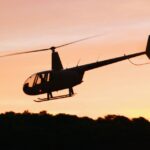
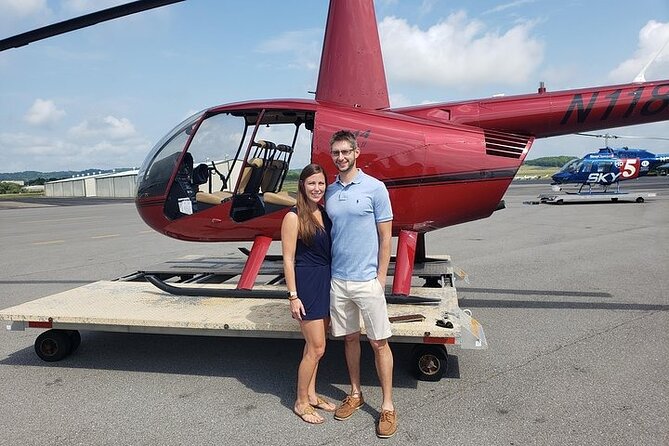
Nashville looks different from the sky. A short, 15-minute helicopter flight turns the city’s top stops into one easy loop, with noise-canceling headphones and a guide calling out landmarks as you go.
I also like the way the max-3 passenger setup keeps the experience personal, with enough space for real questions mid-flight. One thing to consider: you do need to fit the FAA 275 lb weight limit, and each passenger is weighed on arrival.
Five things that make this Nashville helicopter tour work well
- Short flight, big impact: about 15 minutes is just long enough to see the core downtown highlights without feeling dragged out.
- Small group feel: with only a few seats per flight, you get more back-and-forth with the pilot.
- Headphones included: noise-canceling gear makes the ride calmer and helps you hear guidance.
- Photo-friendly route: you’re flying over the stuff people usually line up for on foot, so your camera gets a lot of value fast.
- Many classic Nashville landmarks: Broadway, Tootsie’s area, Centennial Park, Vanderbilt, the state capitol, and ballpark/sports spots are all in the mix.
In This Review
- Why a 15-minute helicopter ride makes Nashville feel instantly bigger
- Where you meet and how the pre-flight moment usually goes
- Broadway from above: neon honky-tonks and the best seat in town
- What I’d watch for with your camera
- Flying over Tootsie’s and the landmarks that people actually name
- Centennial Park’s Parthenon replica: architecture you can measure from the sky
- A small caution for photos
- Sports flyover: Titans and TSU from high above, plus arena and ballpark views
- Vanderbilt University: the green pocket inside the city grid
- Skyline and rivers: downtown’s bigger picture in a single sweep
- Tennessee State Capitol and Fort Negley: history you can see as space
- Why I like this combination
- How to get the most from your photos and questions
- Photo checklist (simple)
- Price and value: is $95 for 15 minutes a good deal?
- Should you book the Downtown Nashville Helicopter Tour?
- FAQ
- How long is the Downtown Nashville Helicopter Tour?
- How much does it cost?
- Where do I meet for the tour?
- What are the weight requirements?
- What’s the group size?
- Is the tour offered in English?
- Is there any weather-related risk?
Why a 15-minute helicopter ride makes Nashville feel instantly bigger
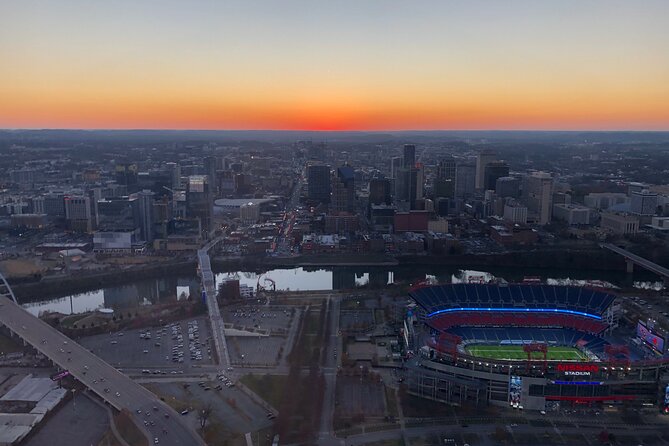
If your Nashville time is tight, this tour has the right rhythm. A full day of sightseeing can feel like a sprint. A helicopter ride flips it: you get height, speed, and perspective in a chunk of time that stays manageable—roughly 15 minutes in the air.
From the sky, downtown stops being a map of streets and turns into a pattern of neighborhoods, stadiums, campuses, parks, and river-like edges. That changes how you understand where things are. Broadway looks different when you can see how the honky-tonk strip stretches and how the rooftops and neon glow relate to each other. Vanderbilt looks like a real green pocket rather than a couple of buildings you pass by.
It’s also a good choice if you want something memorable that isn’t a long drive across town. The route is built around high-recognition sights, so you spend your limited time looking at iconic places instead of spending it in traffic.
Where you meet and how the pre-flight moment usually goes
You’ll start at 220 Tune Airport Dr, Nashville, TN 37209 and then return there after the flight. Because the whole experience is short, show up a little early and follow the route directions carefully—this type of pickup point can be easier to miss than it looks on a map.
A few practical notes to plan around:
- You get a mobile ticket and confirmation at booking.
- The tour runs in English.
- There’s a maximum of 3 passengers per flight, which keeps the cabin calm and organized.
- Service animals are allowed, and the meeting area is near public transportation.
The FAA requirement matters too: each passenger is limited to 275 lbs, and passengers are weighed on arrival. The flight crew keeps that information confidential, so it’s not a public deal—but it still affects how the flight gets scheduled, so don’t show up late or unprepared.
If you’re the type who likes knowing what comes next, this setup helps. You’re not waiting all day, and you’re not stuck in a huge crowd before takeoff.
You can also read our reviews of more tours and experiences in Nashville


Broadway from above: neon honky-tonks and the best seat in town
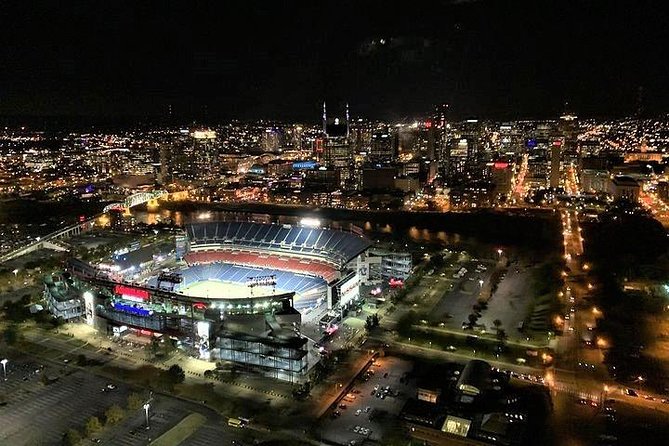
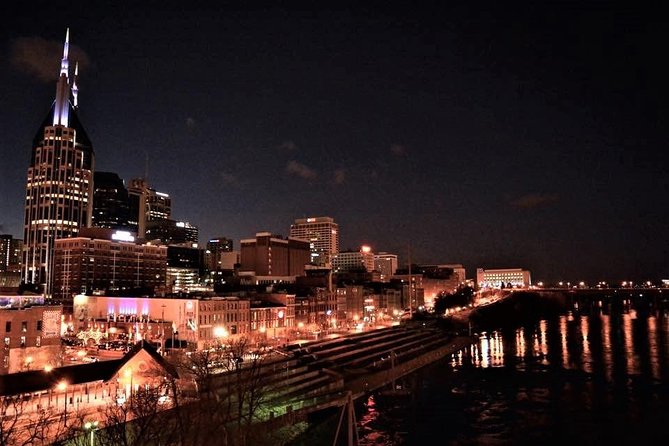
The tour’s first big wow factor is Broadway. From street level, Broadway can feel busy and loud and hard to “read.” From the air, it becomes a continuous strip—neon glowing in patterns, rooftops packed close, and nighttime energy you can actually see.
This is also where the pilot’s commentary makes the experience easier to process. You’re not just looking down randomly; you’re being guided toward what you’re seeing—like the way the honky-tonk cluster looks from overhead and how the nightlife area stretches beyond the most obvious blocks.
If you pick an evening or sunset time slot, the effect gets even better. One common highlight is how the skyline lights up, turning Broadway and downtown into a glowing map rather than a daytime view.
What I’d watch for with your camera
- Shoot short bursts when crossing the densest part of Broadway.
- If it’s sunset, try both: one quick frame as the light changes and one once the lights fully show.
- If your device allows it, switch to a wider lens view to capture rooftops, not just signs.
Flying over Tootsie’s and the landmarks that people actually name
After Broadway, you fly over Tootsie’s—one of those Nashville spots people can point to from memory. Aerial views don’t replace being there, but they do something different: they show the real geometry of the block, how the building sits among other venues, and how the surrounding area supports the vibe.
This is where a helicopter tour becomes more than a novelty. When you can see the location of a landmark in relation to the rest of downtown, you understand why it matters. Later, when you walk around, you’ll be able to orient yourself faster because your brain already has a “from above” reference point.
You also get quick photo opportunities that don’t require standing in a line or fighting shoulder-to-shoulder crowds on the sidewalk. Overhead, you’re taking in the scene, not just grabbing a snapshot.
Centennial Park’s Parthenon replica: architecture you can measure from the sky
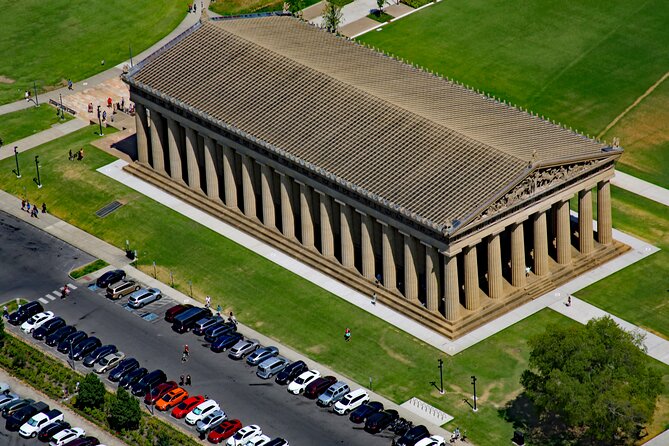
Centennial Park is where the view turns from nightlife to something calmer, and the Parthenon replica is the star. From the air, the big win is symmetry. It’s easier to judge spacing, alignment, and the scale of the structure when you’re not looking at it from one angle on the ground.
This is also the stop that adds context to Nashville’s identity. The helicopter view supports the idea behind the city’s nickname—your eye can trace the formal layout of the park and connect it to how the Parthenon replica signals an “Athens of the South” theme.



A small caution for photos
From above, bright stone structures can look crisp, but sometimes the sky or nearby buildings can overpower contrast. If you’re using a phone, tap to focus, then adjust exposure slightly so the stone details don’t turn flat.
Sports flyover: Titans and TSU from high above, plus arena and ballpark views
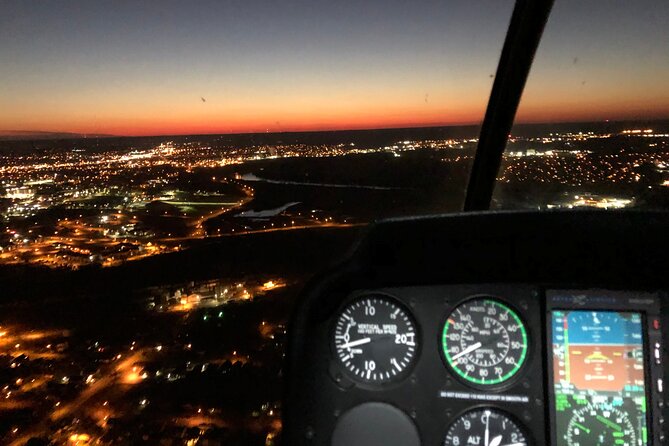
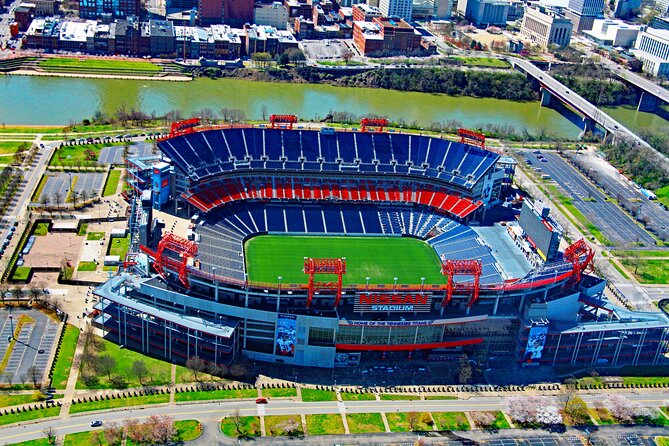
If you’re a sports person, you’ll probably enjoy this part most. The flight circles the home area of the Tennessee Titans and TSU Tigers, giving you a view that feels different from TV because you see the whole bowl and the surrounding layout—not just the field.
Then you fly over major downtown sports venues like:
- Bridgestone Arena, where big events draw crowds.
- First Horizon Park, home of the Nashville Sounds.
One of the best features here is perspective. From street level, stadiums can feel like separate islands. From above, they connect to the city grid, the highways nearby, and the way downtown grows around them. If you’re lucky and it aligns with timing, you might catch hints of game-day energy from the air—like lights or activity in and around the complex.
Vanderbilt University: the green pocket inside the city grid
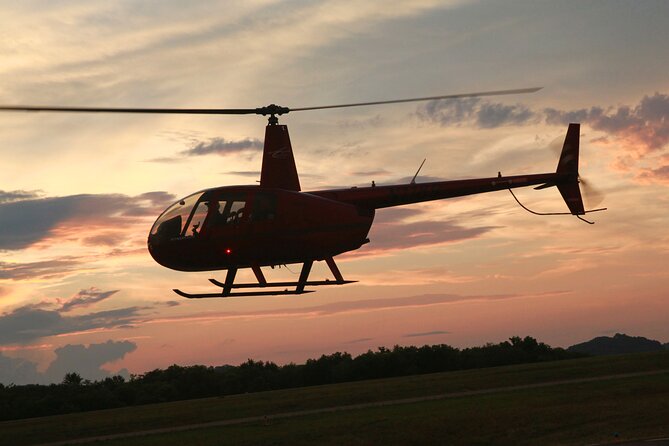
Vanderbilt from above is one of those moments where your brain says, wait, this is right here in downtown. You’ll see the campus as a green oasis surrounded by city movement—historic stone buildings contrasted against modern structures, all set along tree-lined streets.
What makes this stop special is the contrast. Nashville can be a mix of grit and glamour, nightlife and big events. Vanderbilt adds a quieter, more campus-like rhythm. Seeing it from height helps you understand why the campus feels like a pause in the city.
If you’re visiting for the first time and you want a sense of where people spend time during daylight hours—not just where they party at night—this is the view that balances the flight.
Skyline and rivers: downtown’s bigger picture in a single sweep
After the campus and sports stops, the tour centers back on downtown’s skyline and surrounding hills. This is the part that makes the whole ride feel worth it, even if you only care about a few landmarks.
From the helicopter, you can spot:
- downtown’s shape
- major roads and movement corridors
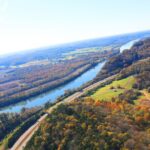
- shimmering stretches of water or river-like edges
- the way surrounding terrain frames the city
This is the kind of view that helps you plan future walks and drives. Once you see the skyline layout from above, you can more easily decide what area you want to explore next.
Also, if you’re booking for a special occasion—birthday, proposal, anniversary—this stretch is where it looks most cinematic, especially during sunset or nighttime.
Tennessee State Capitol and Fort Negley: history you can see as space
The flight doesn’t just hit modern icons. You also pass the Tennessee State Capitol, described as one of the oldest working capitols in the nation, with Greek Revival style and a hilltop presence. From above, it’s easier to appreciate that hilltop location—your eye sees the rise and how it dominates the surrounding area.
Then comes Fort Negley, a Union stronghold with stone remains built after Nashville’s capture during the Civil War. From the air, ruins like this can be surprisingly readable. You’re not only seeing a marker; you’re seeing the shape of the site and how it occupies space.
Why I like this combination
Nightlife and stadiums are fun, but history helps the trip feel grounded. When you add Capitol hill and a Civil War site into a short ride, the tour stops being a pure thrill and becomes a quick education in how Nashville grew.
How to get the most from your photos and questions
A helicopter ride is short. So your best plan is to multitask: listen, glance, then shoot.
A few practical pointers based on how the experience is designed and the pilot-led tone you’ll likely hear:
- Pay attention during crossings. The pilot calls out where you are and what you’re seeing, which helps your photos make sense later.
- Ask questions while you’re up there. With the small max-3 setup, it’s easier to get a real answer than in a larger tour.
- If you’re nervous, know that first-time helicopter riders often feel better once the pilot explains what’s happening and keeps communication clear.
Pilots you might meet include Noah, Travis, Ray, Trevor, Patrick, Mike, and others. You may also have staff such as Brooke greet you. Names change flight to flight, but the common theme is an easy, friendly approach—plus a lot of landmark talk.
Photo checklist (simple)
- Clean your phone lens.
- Turn on burst mode.
- Take one photo of each “anchor” landmark, not just the whole skyline.
- If it’s dark outside, hold steady for a moment after the skyline lights up.
Price and value: is $95 for 15 minutes a good deal?
At $95 per person for about 15 minutes, the price is not “cheap,” and you shouldn’t pretend it is. What you should ask is whether the experience gives you a high return on time, comfort, and memory.
For me, the value case comes down to three things:
1) You’re paying for perspective, not duration.
Aerial views of Broadway, Vanderbilt, the sports venues, and the state capitol are hard to replicate on foot in the same day.
2) The group size keeps it efficient.
A small cabin means you spend less time waiting around and more time looking at the sights. It also makes Q&A easier, which matters when the pilot is pointing out landmarks you might otherwise miss.
3) It’s a flexible way to “compress” a lot of Nashville.
If you’ve got one evening with limited time, or you want a birthday-grade memory without committing to a half-day tour, this fits.
If your top priority is budget, you can do plenty in Nashville without helicopters. But if your priority is a fast, high-impact view of downtown—and you want it to feel special—this price starts to make sense.
One more timing note: this tour is commonly booked about 13 days in advance on average. If you’re traveling during peak seasons or want a specific time (sunset or night), booking ahead pays off.
Should you book the Downtown Nashville Helicopter Tour?
Book it if you want:
- a quick, high-impact Nashville view in about 15 minutes
- a route that covers Broadway, Vanderbilt, sports venues, and landmarks like the capitol and Fort Negley
- a calm flight experience with noise-canceling headphones and a small group
Skip it if:
- you dislike weather-driven activities and hate uncertainty (the flight requires good weather)
- you’re hoping for a long, detailed tour that replaces walking around downtown
- weight-limit rules could affect you (FAA 275 lb per passenger is enforced, with weighing on arrival)
If you’re on the fence, I’d lean toward yes—especially for first-time visits, short stays, or special celebrations—because Nashville is one of those cities where the skyline and layout are part of the story.
FAQ
How long is the Downtown Nashville Helicopter Tour?
The flight time is about 15 minutes.
How much does it cost?
The price is $95.00 per person.
Where do I meet for the tour?
You meet at 220 Tune Airport Dr, Nashville, TN 37209, USA, and the activity ends back at the meeting point.
What are the weight requirements?
Due to FAA requirements, each passenger is limited to 275 lbs. Passengers are weighed upon arrival, and the information is kept confidential with only the flight crew having access.
What’s the group size?
This tour has a maximum of 3 travelers.
Is the tour offered in English?
Yes, it is offered in English.
Is there any weather-related risk?
Yes. The experience requires good weather. If it’s canceled due to poor weather, you’ll be offered a different date or a full refund.